


Updated November 2026. This guide replaces the 2024 version and corrects its main claim. Written by Jess Morgan, MSN, APRN, FNP-C.
Can you take iron and vitamin C together? Yes. Take them at the same meal. Vitamin C helps your gut absorb nonheme iron, which is the iron in beans, grains, fortified foods, and iron pills like ferrous sulfate. About 50 mg of vitamin C with a main meal is the amount the research has pointed to since the 1980s.
That is the short answer. The useful answer is longer, because the effect is bigger in some situations than others, a few everyday habits can cancel it out, and a small group of people should not do this at all.
The quick answer.
- Together is fine, and better with food. Vitamin C and iron work at the same meal. Vitamin C taken with breakfast did not change iron absorption from lunch or dinner in one classic study.
- About 50 mg of vitamin C per main meal is the amount researchers have suggested for the best effect. A serving of citrus, strawberries, or bell pepper on the plate does the same job as a tablet.
- The effect is real in a single meal and much smaller across a whole day. A 5-day study of complete diets found no significant difference in iron absorption across vitamin C intakes from 51 to 247 mg a day.
- If you are treating diagnosed iron deficiency anemia with pills, a 2020 trial of 440 adults found 200 mg of vitamin C added no measurable gain over iron alone. A 2024 gastroenterology guidance still advises adding it. Neither is a reason to skip a vitamin C food.
- The bigger levers are elsewhere: coffee, tea, and calcium at the same meal, and dosing iron once a day at most, or every other day.
- Test ferritin before you supplement. And skip the iron and the extra vitamin C if you have hemochromatosis or any known iron overload.
Why does vitamin C help iron absorb?
Your body handles iron from meat differently from iron in plants. Iron in plants and fortified foods is called nonheme iron, and it is hard to absorb. A large part of the reason is what travels with it. Grains and beans carry phytate, and tea, coffee, and many vegetables carry polyphenols. Both bind iron and hold it in a form your gut cannot easily take up.
Vitamin C works on that problem. Teucher and colleagues, reviewing the field in 2004, describe ascorbic acid as the most efficient enhancer of nonheme iron absorption, because of its reducing and chelating properties. In plain terms, it helps keep iron in a form your gut can use. Hallberg’s group, who tested 299 people across different meals in 1986, suggested something more specific: vitamin C mainly works by undoing the damage that phytates and tannins do. That fits what they saw. The biggest boosts came in meals that were already loaded with those blockers.
Two more details from that research are worth knowing. Vitamin C from food and vitamin C from a tablet behaved the same way. And meat, poultry, and seafood also raise nonheme iron absorption, according to the NIH Office of Dietary Supplements, which is why the benefit of added vitamin C is smaller at a meal that already has meat.
How much vitamin C should you take with iron?
About 50 mg per main meal. That figure comes from Hallberg’s 1986 study, which concluded that roughly 50 mg of vitamin C in each main meal is desirable for the best effect. You do not need to chase more than that to get the benefit.
If you want the dose-response picture, the old but careful numbers come from Cook and Monsen, who tested 63 men in 1977. They gave a meat-free test meal with different amounts of vitamin C and measured how much iron the men absorbed compared with the same meal without it. The increase rose in step with the dose across a range of 25 to 1,000 mg. At 25 mg, absorption was 1.65 times higher. At 1,000 mg, it was 9.57 times higher. They also noted the relative increase was substantially smaller when the meal contained meat.
| Vitamin C added | Iron absorption compared with the same meal without vitamin C |
|---|---|
| 25 mg | 1.65 times |
| 1,000 mg | 9.57 times |
| Complete 5-day diet with 51 to 247 mg of vitamin C a day | No significant difference in mean iron absorption |
One more point from that 1977 study matters for daily life. A large dose of vitamin C taken with breakfast did not change iron absorption from the noon or evening meal. Vitamin C works on the meal it travels with. It is not a bank you fill once and draw on all day. That is why the useful move is vitamin C at the meal with the iron, not a big dose at some other time.
Teucher’s review adds a way to think about proportions. For meals with low to medium levels of blockers, a vitamin C to iron ratio of 2 to 1 by molecules (for example, 20 mg of vitamin C for 3 mg of iron) was enough. Meals heavy in blockers needed more than 4 to 1, which the authors call impractical. You do not need to calculate this at home. It explains why the same orange juice helps more with a bowl of bran cereal than with a steak.
What about the upper limit?
The NIH sets the Tolerable Upper Intake Level for vitamin C at 2,000 mg a day for adults. The usual trouble above that is digestive: diarrhea, nausea, and cramps. The recommended intake is 90 mg a day for men and 75 mg for women, so 50 mg with a meal is not a megadose. The upper limit for iron is 45 mg a day for adults, and many iron-only supplements contain more than that in a single tablet, with 65 mg listed as common. Anything above the upper limit should be on a clinician’s plan, not a guess.
Does it still work over a whole day of eating?
This is where the old version of this article got it wrong, and it is worth saying plainly. The 2024 post said vitamin C could raise iron absorption “up to 4x” and credited the NIH. We could not find that figure in the NIH fact sheet or in the studies behind it, so it is gone. What the research supports is both more interesting and more modest.
In single meals eaten after fasting, vitamin C has a pronounced effect, and the Cook and Monsen ratios above are real. But Cook and Reddy asked a better question in 2001: what happens with a complete diet, day after day? They had 12 people eat a labeled wheat roll with every meal for five days across three diets, with vitamin C intake ranging from 51 to 247 mg a day. There was no significant difference in mean iron absorption among the three periods. Vitamin C did still show up in their statistical model as a positive factor, alongside animal tissue, and phosphate worked against absorption. They concluded the effect of vitamin C from a complete diet is far less pronounced than from single meals. They noted this may explain why long-term vitamin C supplementation trials have shown little effect on iron status.
Hurrell and Egli, writing in 2010, reach the same place. Single-meal studies show the effects of phytate, polyphenols, calcium, vitamin C, and muscle tissue repeatedly. In multi-meal studies with varied diets, the effect of any single component is more modest. And they point out that a person’s own iron status generally has a greater effect on absorption than the makeup of the diet.
What this means for you.
Vitamin C is a sensible habit at an iron-containing meal, especially one built on grains and beans. It is not a lever strong enough to fix a real deficiency by itself. If your iron is low, the first step is finding out how low, not adding a vitamin.
Should you take a vitamin C supplement with your iron pill?
If you have been told you have iron deficiency anemia and you are on iron pills, the honest answer is that two good sources disagree a little.
A randomized trial published in JAMA Network Open in 2020 enrolled 440 adults with newly diagnosed iron deficiency anemia. Half took a 100 mg iron tablet plus 200 mg of vitamin C every 8 hours. Half took the iron tablet alone. After two weeks, hemoglobin had risen by 2.00 g/dL in the vitamin C group and 1.84 g/dL in the iron-only group, a gap of 0.16 g/dL that met the researchers’ standard for equivalence. At eight weeks, ferritin had risen by 35.75 ng/mL with vitamin C and 34.48 ng/mL without. Side effects were about the same, at roughly 21 percent in both groups. The authors concluded oral iron alone was equivalent.
On the other side, the American Gastroenterological Association’s 2024 clinical practice update on iron deficiency anemia lists “add vitamin C to oral iron supplementation to improve absorption” among its best practice advice. That guidance is drawn from a review of the literature and expert opinion. The authors say it carries no formal ratings of evidence quality.
How to hold both: vitamin C is cheap and low risk, so there is little downside to a vitamin C food or a modest tablet with your iron. But do not assume it is doing the heavy lifting, and do not stop iron because you ran out of vitamin C.
What blocks iron absorption?
For most people, the habits that quietly cancel iron do more damage than any vitamin C boost can repair. The research is old and consistent. Figure 2 shows the main offenders with the numbers each study reported.
| Item | Reduction in iron absorption | Test meal and study |
|---|---|---|
| Black tea | 79 to 94 percent | With a bread meal, Hurrell 1999 |
| Phytate, 25 mg phytate phosphorus | 64 percent | Added to a roll, Hallberg 1989 |
| Calcium, 165 mg | 50 to 60 percent | As milk, cheese, or calcium chloride, Hallberg 1991 |
| Chamomile tea | 47 percent | With a bread meal, Hurrell 1999 |
| One cup of coffee | 39 percent | With a hamburger meal, Morck 1983 |
Tea and coffee
Morck’s group found that a cup of coffee cut iron absorption from a hamburger meal by 39 percent, compared with 64 percent for tea. With a simpler test meal, instant coffee dropped absorption from 5.88 percent to 0.97 percent, and doubling the strength cut it further, to 0.53 percent. The effect rose with the strength of the coffee.
Timing matters, and this is the one place the research gives us a real number. When coffee was taken one hour before the meal, there was no decrease in iron absorption. When it was taken one hour after, the inhibition matched drinking it with the meal. So finishing your coffee an hour ahead of the iron is fine. Drinking it right after is not.
Tea is harsher still. Hurrell’s group tested beverages in 1999 and found black tea cut absorption by 79 to 94 percent. Herbal teas count too: peppermint tea cut it by 84 percent, cocoa by 71 percent, and chamomile by 47 percent. Adding milk to coffee or tea made little or no difference to the effect. The reason is the polyphenols in each cup. The more polyphenols per serving, the larger the drop: beverages with 20 to 50 mg per serving reduced absorption by 50 to 70 percent, and those with 100 to 400 mg reduced it by 60 to 90 percent.
Honest limit: the one-hour timing result is for coffee. We could not find the same timing test for tea. Treating tea like coffee is a sensible precaution, but it is a precaution, not a proven interval.
Calcium
Calcium is the blocker that also affects meat iron. Hallberg’s 1991 experiments on 126 people found that 165 mg of calcium, from milk, cheese, or calcium chloride, cut iron absorption by 50 to 60 percent, and doses between 300 and 600 mg did about the same. The same amount of calcium also reduced absorption of heme iron, the kind in meat, which suggests calcium interferes with how iron crosses the gut wall rather than only binding it in the food. That matters if you take a calcium supplement. It also means a glass of milk with your iron-fortified cereal is working against you.
Phytate and polyphenols in food
Phytate is in whole grains, bran, and beans. Hallberg’s 1989 experiment on dose is striking: adding just 2 mg of phytate phosphorus to a roll cut iron absorption by 18 percent, 25 mg cut it by 64 percent, and 250 mg cut it by 82 percent. Vitamin C counteracted it. In a later study of 199 people, Siegenberg’s group found that 30 mg of vitamin C overcame the inhibition from bran containing 10 to 58 mg of phytate phosphorus, and that 50 mg or more would be needed to overcome the effect of any meal with more than 100 mg of tannic acid.
Plant polyphenols can be dramatic. In a Thai study, a common 20 g portion of one leafy vegetable cut iron absorption by almost 90 percent, and as little as 5 g cut it by 75 percent. Adding 100 mg of vitamin C halved the inhibition from the 5 g portion. The point is not to avoid vegetables. It is that vitamin C pairs best with the meals that need it most.
When should you take iron, and how often?
Three decisions matter here: time of day, with food or without, and every day or every other day.
| Step | Guidance | Evidence |
|---|---|---|
| Before the dose | Coffee finished at least 1 hour ahead | Measured: Morck 1983 |
| At the iron dose | A vitamin C food or tablet, plus whatever food keeps your stomach settled | From same-meal studies |
| Keep away from the dose | Calcium (milk, cheese, calcium supplements), tea, cocoa, herbal tea | No study tested exact gaps; treat as a precaution |
| After the dose | Coffee within 1 hour blocks as much as coffee with the meal | Measured: Morck 1983 |
With food or on an empty stomach?
The NIH notes that taking iron supplements with food can help minimize side effects, which include stomach upset, constipation, nausea, abdominal pain, vomiting, and diarrhea. Food also brings blockers, so what is on the plate matters more than the fact that there is a plate. A reasonable setup is iron with a plain meal that includes a vitamin C food, and without dairy, coffee, or tea.
Every day, or every other day?
Here the newer research has changed the advice. Older guidance said to give iron daily and split it through the day. Stoffel and colleagues tested that in iron-depleted women (ferritin 25 µg/L or lower) and found the opposite.
In one trial, 40 women took 60 mg of iron either on consecutive days or on alternate days. The alternate-day group absorbed a larger share of their iron: 21.8 percent versus 16.3 percent, and their total iron absorption was 175.3 mg versus 131.0 mg. The reason is a hormone called hepcidin. In the follow-up study, it rose after an iron dose and stayed elevated for 24 hours, which reduced how much of the next day’s dose was absorbed. In a second trial, splitting 120 mg into two doses a day raised hepcidin and did not improve absorption (11.8 percent once daily versus 13.1 percent twice daily, not a significant difference).
| Measure | Consecutive days | Alternate days | p value |
|---|---|---|---|
| Fractional iron absorption (geometric mean) | 16.3 percent | 21.8 percent | 0.0013 |
| Cumulative total iron absorbed | 131.0 mg | 175.3 mg | 0.0010 |
| 120 mg split into two daily doses: once daily versus twice daily | 11.8 percent once daily | 13.1 percent twice daily (hepcidin was higher with twice-daily dosing) | 0.33 |
A follow-up in women who actually had iron deficiency anemia, published in Haematologica in 2020, found the same pattern. Absorption on day 2 and day 5 was 40 to 50 percent higher than on day 3, and a single 200 mg dose taken on alternate days delivered about twice the total absorbed iron of 100 mg taken on consecutive days. That was a small study of 19 women, so treat it as supportive, not final.
The AGA’s 2024 guidance lands in the same place: give oral iron once a day at most, and note that every-other-day dosing may be better tolerated for some people with similar absorption. Your provider can tell you which fits your numbers. Do not change a prescribed dose on your own.
Iron from meat versus iron from plants
Iron in meat, called heme iron, is absorbed more readily than the nonheme iron in plants. The NIH puts the bioavailability of iron at roughly 14 to 18 percent from mixed diets that include substantial meat, seafood, and vitamin C, versus 5 to 12 percent from vegetarian diets, in people with no iron stores. Because of that gap, the NIH says people who follow a vegetarian diet need 1.8 times as much iron as those who eat meat. The recommended daily amount is 8 mg for men, 18 mg for women aged 19 to 50, 27 mg in pregnancy, and 8 mg for women over 50.
| Measure | Value |
|---|---|
| Mixed diet with substantial meat, seafood, and vitamin C: share of dietary iron absorbed | 14 to 18 percent |
| Vegetarian diet: share of dietary iron absorbed | 5 to 12 percent |
| Vegetarian iron requirement | 1.8 times higher |
| Recommended daily iron, men | 8 mg |
| Recommended daily iron, women 19 to 50 | 18 mg |
| Recommended daily iron, pregnancy | 27 mg |
| Recommended daily iron, women 51 and older | 8 mg |
Women’s recommended intake is more than double men’s through age 50 (18 mg versus 8 mg), which is one reason iron belongs in any conversation about women’s health. If you eat little or no meat, the vitamin C and blocker-avoiding habits in this guide matter more for you than for someone eating a mixed diet.
Hurrell and Egli add one caution worth remembering: a person’s own iron status generally has a greater effect on how much iron is absorbed than diet composition does. Your labs tell you more than your menu.
Can you take a multivitamin and iron together?
This question brings a lot of readers here, so here is the clear version. Many multivitamins already contain iron. The NIH says multivitamin and mineral supplements with iron, especially those designed for women, typically provide 18 mg, which is 100 percent of the Daily Value, and iron-only supplements usually provide more, with many at 65 mg. So before you add an iron pill to a multivitamin, add up the total against the 45 mg upper limit.
Then check the label for calcium. Calcium cut iron absorption by 50 to 60 percent at 165 mg in Hallberg’s experiments. If a product holds both calcium and iron, you may be absorbing less iron than the label suggests. Taking an iron-only supplement at a different meal than a calcium-containing product avoids that.
Do you actually need more iron?
Most people reading about vitamin C and iron are really asking a different question: why am I so tired, and could it be iron? Start with the test, not the supplement.
NIH describes people with iron deficiency anemia as experiencing weakness, fatigue, difficulty concentrating, and gastrointestinal disturbances. Every one of those also shows up with thyroid problems, hormone shifts, poor sleep, and low vitamin B12. That overlap is why guessing goes wrong in both directions. If your fatigue has a different cause, iron will not touch it and can cause side effects of its own.
Check first: ask for ferritin.
Ferritin is the blood test that reflects your iron stores. Iron depletion can exist before anemia does: Stoffel’s group studied women who were iron depleted (ferritin 25 µg/L or lower) without anemia, which is why a hemoglobin check alone can miss it.
A 2021 Cochrane review pooled nine studies of 512 adults who were not healthy and found that a ferritin cutoff of 30 µg/L picked up iron deficiency with 79 percent sensitivity and 98 percent specificity (low-certainty evidence). Translation: a low result is very trustworthy, and a normal one does not completely rule deficiency out. Ferritin also rises with inflammation and infection, so a recent illness can mask a low reserve. Ask your provider to read the result in context.
| Step | Guidance | Source |
|---|---|---|
| Start | Feeling worn down? Ask for ferritin before you supplement. | Garcia-Casal 2021 (Cochrane) |
| Ferritin low | Trial of oral iron: once a day at most, or every other day. Vitamin C food or tablet is reasonable. Keep coffee, tea, and calcium away from the dose. | DeLoughery 2024 (AGA), Stoffel 2017 |
| Then | Recheck ferritin after a trial of oral iron. | DeLoughery 2024 (AGA) |
| If oral iron fails | Not tolerated, ferritin not improving, or a condition that blocks absorption (for example, bariatric surgery, or celiac disease that has not responded): IV iron is considered. | DeLoughery 2024 (AGA) |
| Ferritin high, or hemochromatosis or iron overload in the family | Do not add iron or high-dose vitamin C on your own. Talk to your provider. | NIH ODS fact sheets, Gerster 1999 |
Here is the short version of the “normal labs, still exhausted” problem, from our own channel.
Jess explains: "Normal" Labs but Still Exhausted? You Might Be Iron Deficient
If you have been told your labs are normal and you still feel off, why “normal” labs can still leave you feeling terrible and why thyroid labs can look normal when you still feel awful walk through other common causes. Our concierge primary care membership is $115 a month and offers same-day or next-day appointments, so a provider who knows your history can work through that list with you.
Who should not take extra iron or vitamin C?
If you have hemochromatosis or another iron overload condition, this article is not for you, and the answer is different. The NIH notes that in people with hereditary hemochromatosis, chronic consumption of high doses of vitamin C could exacerbate iron overload and result in tissue damage.
The evidence is more nuanced than a blanket ban. Gerster’s 1999 review found that even high vitamin C intakes do not cause iron imbalance in healthy people, and probably not in people who carry one copy of the hemochromatosis gene. But the effect of high-dose vitamin C on iron absorption in people with two copies, the true iron overload disease, has not been studied, and those patients should avoid anything that facilitates iron absorption and limit their iron intake. Iron overload from repeated transfusions or conditions like sickle cell anemia needs specialist management as well.
You are a person to ask a provider first if any of these are true: a prior lab showed high ferritin, a close relative has hemochromatosis, you have been told your iron runs high, or you have unexplained fatigue with high iron on a past lab.
Skip this if iron could already be high.
Do not take iron supplements or high-dose vitamin C to “boost” your levels until a ferritin result tells you where you stand. More is not automatically safer.
When pills do not work: what IV iron is for
If you try oral iron and your ferritin does not improve, the next conversation is about getting iron in without relying on your gut. The AGA’s 2024 guidance says intravenous iron should be used if a patient does not tolerate oral iron, if ferritin does not improve with a trial of oral iron, or if the person has a condition in which oral iron is not likely to be absorbed. It specifically calls out people who have had bariatric surgery that disrupts the part of the gut where iron is normally absorbed, and people with celiac disease whose iron stores do not improve despite a gluten-free diet and an oral trial. It also notes that true anaphylaxis is very rare and that most reactions to IV iron are infusion reactions.
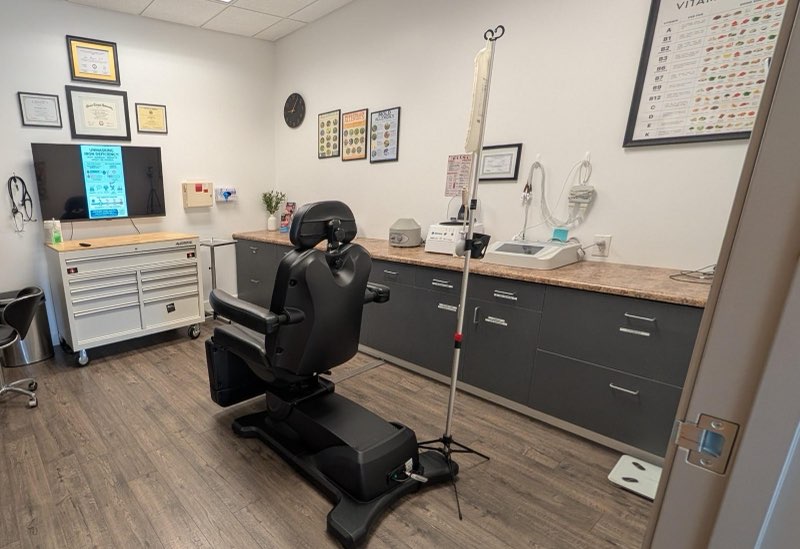
At Total Medical & Wellness, our IV nutrition menu includes an Iron Infusion, listed from $350, and our page notes same-day appointments with no referral needed. It is not the first step. The order in the flow chart above still applies: test, trial, recheck. If you are weighing it, bring your ferritin result to the visit so your provider can look at the same numbers you are.
A separate item on the same menu, high-dose vitamin C by IV, is a different treatment with a different purpose, and it requires a G6PD lab before your first treatment. We cover that in the benefits of high-dose vitamin C infusions. It is not a way to absorb more iron.
If your fatigue is more about energy than iron, our guide to B12 injections covers another common deficiency worth ruling out.
Simple ways to pair them at meals
You do not need a supplement to get the benefit. Since vitamin C from food works the same as vitamin C from a tablet, any meal that carries iron can carry vitamin C with it. Grains and beans are the best targets, because phytate is exactly what vitamin C counters.
- A bean or lentil dish with tomatoes or bell peppers.
- Iron-fortified cereal with strawberries or a small glass of orange juice, and without milk or coffee at the same sitting.
- A grain bowl with citrus dressing.
- An iron pill with a piece of fruit, not with coffee or dairy.
Cooking can destroy vitamin C, according to Teucher’s review, so raw or lightly cooked sources are the safer bet.
Frequently Asked Questions
Can you take vitamin C and iron together?
Yes. Taking them together at a meal is the setup the research supports. Vitamin C helps your gut absorb nonheme iron, which is the iron in plants, fortified foods, and ferrous sulfate supplements. The benefit is largest when the meal contains phytate or polyphenols, as bean and grain meals do.
How much vitamin C should you take with iron?
About 50 mg with each main meal is the amount that has been suggested for the best effect. Larger single doses increase absorption further in a single test meal, but across a full day of eating the added effect is small. The upper limit for vitamin C is 2,000 mg a day for adults.
Can iron and vitamin C be taken at the same time?
Yes. There is no reason to separate them. Vitamin C works on the meal it is eaten with, so taking it at the same time as the iron is what makes it useful. A large dose of vitamin C at breakfast did not change iron absorption at lunch or dinner in one study.
Does vitamin C help iron absorption?
It does in a single meal, and the effect depends on the meal. The increase was 1.65 times at 25 mg and 9.57 times at 1,000 mg in a meat-free test meal. Over several days of ordinary eating, though, one study found no significant difference in iron absorption across a wide range of vitamin C intakes.
Is it okay to take vitamin C and iron together at night?
We found no study that tested bedtime dosing specifically. The timing that has evidence behind it is about what the iron meets: avoid calcium, tea, and cocoa near the dose, and avoid coffee within an hour after it. The NIH notes that taking iron with food can reduce stomach upset.
What is the best time to take iron and vitamin C?
The trials of dosing schedules gave iron in the morning, at 8 AM, with every-other-day dosing performing better than daily. The best time for you is whichever lets you keep coffee, tea, and calcium away from the dose and take it consistently. Ask your provider whether every-other-day dosing suits your situation.
Can you take a multivitamin and iron together?
You can, but check the totals. Many multivitamins already contain iron, commonly 18 mg, and the upper limit for iron is 45 mg a day for adults. Calcium in a multivitamin can also cut iron absorption by 50 to 60 percent, so a combined product may deliver less iron than you expect.
Can vitamin C cause high iron levels?
In healthy people, even high vitamin C intakes do not appear to cause iron imbalance, according to a 1999 review. The exception is people with iron overload conditions such as hereditary hemochromatosis. In them, high-dose vitamin C could make iron buildup worse, and they should talk to a provider first.
What foods and drinks block iron absorption?
Coffee, tea, herbal teas, cocoa, calcium-rich foods such as milk and cheese, and phytate-rich foods such as bran and beans can all reduce how much iron you absorb. In the studies, black tea cut absorption by 79 to 94 percent and a cup of coffee by 39 percent in a hamburger meal. Vitamin C and meat both help counter these effects.
How do I know if I actually have iron deficiency?
A ferritin blood test is the most useful starting point, because it reflects your iron stores. Hemoglobin can be normal while stores are low. Common signs of iron deficiency anemia include fatigue, weakness, difficulty concentrating, and digestive upset, but they overlap with other conditions, so guessing is unreliable.
Is it better to take iron every day or every other day?
In iron-depleted women, taking the same dose every other day gave better absorption than every day (21.8 percent versus 16.3 percent in one trial). The AGA’s 2024 guidance advises oral iron once a day at most and notes that every-other-day dosing may be better tolerated. Your provider can recommend a schedule that fits you.
When is IV iron considered?
Guidance from the American Gastroenterological Association says IV iron should be used when someone cannot tolerate oral iron, when ferritin does not improve with a trial of oral iron, or when a condition makes oral iron unlikely to be absorbed, including some bariatric procedures. It is decided case by case with a provider after labs.
Where to start
Start with a number. A ferritin result takes a blood draw and turns a guess into a plan: whether you need iron at all, how to dose it, and whether vitamin C is worth thinking about. We test ferritin along with thyroid and hormone labs at our Glendale clinic. If you want a provider to look at it alongside your symptoms, contact us or call (623) 259-6900. If you already have results and iron is not working, our IV nutrition page lists what we offer.
Serving Glendale, Peoria, Surprise, and the greater Phoenix West Valley.
Sources & References
- Cook JD, Monsen ER. Vitamin C, the common cold, and iron absorption. Am J Clin Nutr, 1977;30(2):235-241. PMID 835510.
- Hallberg L, Brune M, Rossander L. Effect of ascorbic acid on iron absorption from different types of meals. Hum Nutr Appl Nutr, 1986;40(2):97-113. PMID 3700141.
- Hallberg L, Brune M, Rossander L. Iron absorption in man: ascorbic acid and dose-dependent inhibition by phytate. Am J Clin Nutr, 1989;49(1):140-144. PMID 2911999.
- Siegenberg D, Baynes RD, Bothwell TH, et al. Ascorbic acid prevents the dose-dependent inhibitory effects of polyphenols and phytates on nonheme-iron absorption. Am J Clin Nutr, 1991;53(2):537-541. PMID 1989423.
- Tuntawiroon M, Sritongkul N, Brune M, et al. Dose-dependent inhibitory effect of phenolic compounds in foods on nonheme-iron absorption in men. Am J Clin Nutr, 1991;53(2):554-557. PMID 1989426.
- Hallberg L, Brune M, Erlandsson M, Sandberg AS, Rossander-Hulten L. Calcium: effect of different amounts on nonheme- and heme-iron absorption in humans. Am J Clin Nutr, 1991;53(1):112-119. PMID 1984335.
- Morck TA, Lynch SR, Cook JD. Inhibition of food iron absorption by coffee. Am J Clin Nutr, 1983;37(3):416-420. PMID 6402915.
- Hurrell RF, Reddy M, Cook JD. Inhibition of non-haem iron absorption in man by polyphenolic-containing beverages. Br J Nutr, 1999;81(4):289-295. PMID 10999016.
- Cook JD, Reddy MB. Effect of ascorbic acid intake on nonheme-iron absorption from a complete diet. Am J Clin Nutr, 2001;73(1):93-98. PMID 11124756.
- Teucher B, Olivares M, Cori H. Enhancers of iron absorption: ascorbic acid and other organic acids. Int J Vitam Nutr Res, 2004;74(6):403-419. PMID 15743017.
- Hurrell R, Egli I. Iron bioavailability and dietary reference values. Am J Clin Nutr, 2010;91(5):1461S-1467S. PMID 20200263.
- Stoffel NU, Cercamondi CI, Brittenham G, et al. Iron absorption from oral iron supplements given on consecutive versus alternate days and as single morning doses versus twice-daily split dosing in iron-depleted women: two open-label, randomised controlled trials. Lancet Haematol, 2017;4(11):e524-e533. PMID 29032957.
- Stoffel NU, Zeder C, Brittenham GM, Moretti D, Zimmermann MB. Iron absorption from supplements is greater with alternate day than with consecutive day dosing in iron-deficient anemic women. Haematologica, 2020;105(5):1232-1239. PMID 31413088.
- Li N, Zhao G, Wu W, et al. The efficacy and safety of vitamin C for iron supplementation in adult patients with iron deficiency anemia: a randomized clinical trial. JAMA Netw Open, 2020;3(11):e2023644. PMID 33136134.
- DeLoughery TG, Jackson CS, Ko CW, Rockey DC. AGA clinical practice update on management of iron deficiency anemia: expert review. Clin Gastroenterol Hepatol, 2024;22(8):1575-1583. PMID 38864796.
- Garcia-Casal MN, Pasricha SR, Martinez RX, Lopez-Perez L, Peña-Rosas JP. Serum or plasma ferritin concentration as an index of iron deficiency and overload. Cochrane Database Syst Rev, 2021;5:CD011817. PMID 34028001.
- Gerster H. High-dose vitamin C: a risk for persons with high iron stores? Int J Vitam Nutr Res, 1999;69(2):67-82. PMID 10218143.
- National Institutes of Health, Office of Dietary Supplements. Iron: Fact Sheet for Health Professionals. https://ods.od.nih.gov/factsheets/Iron-HealthProfessional/ Accessed November 19, 2026.
- National Institutes of Health, Office of Dietary Supplements. Vitamin C: Fact Sheet for Health Professionals. https://ods.od.nih.gov/factsheets/VitaminC-HealthProfessional/ Accessed November 19, 2026.
This article is for educational purposes and is not medical advice. Individual results vary. If you have a known iron overload condition, are pregnant, take medications, or are unsure whether iron or vitamin C supplementation is right for you, talk with a licensed provider before changing your routine.